What Type of Art Style Is the Old Godzilla Movie
The 1954 flick Godzilla, with its brilliant combination of miniature sets and costumed actors, gave nascency to a whole new genre, called tokusatsu (literally "special filming"). This distinctive mode, pioneered by Tsuburaya Eiji, went on to get hugely influential in Japan and overseas, leading to many other memorable creations, including the Idiot box prove Ultraman. Hikawa Ryūsuke looks at the nascence and development of this genre.
Tokusatsu'due south Global Fans
The tokusatsu genre of movies and Tv series, which relies on tangible "analog" special furnishings, is one of the all-time-loved elements of Japanese pop civilisation. The genre involves creatively filming highly detailed real objects, such every bit miniature sets and actors dressed in monster suits, to convincingly portray scenes of gigantic monsters in bodily cityscapes.
The term tokusatsu is short for tokushu satsuei, which literally means "special filming." At present, the term basically designates two different things:
(1) A technique used to film images of things or objects that are commonly difficult to film.
(2) The flick or TV-series genre that relies heavily on "special filming" techniques, as seen in such works equally Godzilla or Ultraman.
Starting around the mid-1990s, creators made less use of the traditional techniques pertaining to tokusatsu in that first sense, such as the utilize of miniature objects, as reckoner graphics and other types of digital technologies became cheaper and more sophisticated. The use of miniatures has also get limited for the second type of tokusatsu, which now centers by and large on Television shows featuring life-size heroes similar Kamen Rider or Super Sentai.
There accept been 28 movies featuring the monster Godzilla produced in Nippon, but no new movie has been released since Godzilla: Final Wars was on the big screen 10 years ago. And although there are withal new works being made that feature the famous monsters and familiar heroes of the Ultraman serial, it has become rare to encounter scenes of city destruction filmed with the use of miniatures.
The quintessential tokusatsu scenes, depicting epic battles between enormous-looking monsters and heroes, are becoming a rarity in Nihon. Meanwhile, though, the respect overseas for the tokusatsu genre is on the rise. In 2013, the US moving-picture show Pacific Rim featured giant robots clashing with monsters. And in May 2014, Hollywood released a new Godzilla pic that has go a box-office hitting worldwide. (The picture will be released in Nihon on July 25.) Both films spent lavishly on computer graphics to create scenes of monsters wreaking havoc on people'southward lives, similar to the images that Japanese films used to exist known for.
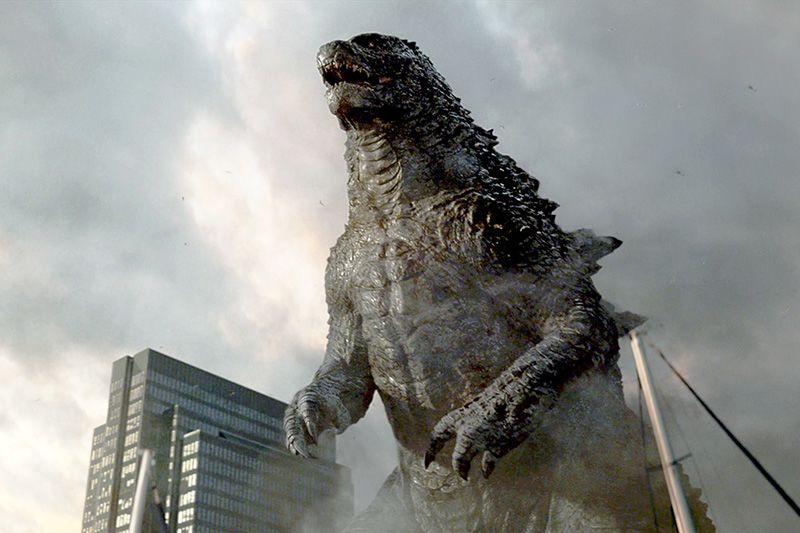 The 2014 Hollywood movie Godzilla will exist released in Japan on July 25. (Photograph courtesy of Warner Bros. Entertainment Inc. & Legendary Pictures Productions LLC.)
As a way of bridging the gap between these latest films and what came earlier, I'd like to take a wait here at the cultural aspects of Japan'southward tokusatsu tradition.
The Heyday of Tokusatsu and Anime
From around 1954 to 1970, which overlapped with Nihon's extended catamenia of high economic growth, special-effects director Tsuburaya Eiji helped create a number of tokusatsu films that were shown outside of Nihon to global acclamation. These films also inspired children in various countries who would go on to become visual creators themselves as adults.
That era, stretching from the release of the starting time Godzilla movie in 1954 up to Tsuburaya'due south expiry in 1970, could be called the get-go "aureate age" of tokusatsu. And up to the latter half of the 1970s, tokusatsu was on equal basis with anime in the realm of visual creations geared to kids, with both genres progressing through a process of cantankerous-pollination.
But today tokusatsu, unlike anime, is not included as one of the categories for the Japan Media Arts Festival. This seems to reflect how the prestige of the tokusatsu genre has faded while that of anime has been on the rise. Overseas, however, at that place are those who have appropriately grasped the close relationship between the two genres and their respective characteristics, and and then I think it is necessary here for me to look at this as well.
Made-in-Japan animation has become familiar to viewers around the world, who refer to it using the Japanese term "anime." The growth of anime can be traced back to 1963, when Tezuka Osamu, known as the "god of manga," released a Goggle box serial through his Mushi Production company that adjusted his own famous manga graphic symbol, Tetsuwan Atomu (Astro Boy). Different the total animation of Western Europe, the animation for this series used many freeze-frames, incorporating the concept of omission and exaggeration. Past coming up with ways to limit the number of images used per second, Tezuka developed his own style of "limited blitheness," making it possible to produce a 30-minute animated Tv plan every week.
Similarly, the term tokusatsu, which basically means "visual furnishings," has taken on its own new meaning. Information technology is an example of how Japan, as an isle state with limited resource, has given its own twist to techniques and cultural elements originating overseas and come with innovative ways to make those things more compact and efficient—before then sending those readaptations back out into the world. That arroyo is at the basis of both anime and tokusatsu.
Necessity Is the "Monster" of Invention
So what innovations did Nihon bring to the realm of visual effects to forge the tokusatsu style? The roots of its innovations can exist traced back to the original 1954 Godzilla motion-picture show, the box-office smash produced by the Tōhō film company. The period from initial planning to the actual release of the motion picture was only six months. Since Tsuburaya, who was in charge of special furnishings, had only this short period of time to film everything he could not rely on the time-consuming "stop-motion blitheness" technique that had been the standard technique overseas for producing the monster movies of the 1930s. Instead, he adopted the method of creating a miniature ready of Tokyo and having an player dressed up in a Godzilla costume play the function of the monster.
 The 1954 movie Godzilla, whose special furnishings were created by Tsuburaya Eiji, is winning new fans thank you to a digitally remastered version of the movie released in 2014 to mark its 60th anniversary. (Photo courtesy of Tōhō Co. Ltd.)
There were concerns that the film might look cheap because of this approach, but in fact using the 100-kilogram-plus Godzilla suit gave a weighty presence to the monster and the rough plastic peel of the monster was also rich in texture. The moving picture also made use of hand-held puppet versions of Godzilla for scenes where the monster needed to open up its oral cavity or use facial expressions, also equally another version of Godzilla whose lower-half only was filmed for scenes where the monster crushes city buildings. This way of "putting the right monster in the right scene" brought the image to life and created an unprecedented sort of realism that made viewers almost think they were viewing a living animal on the screen.
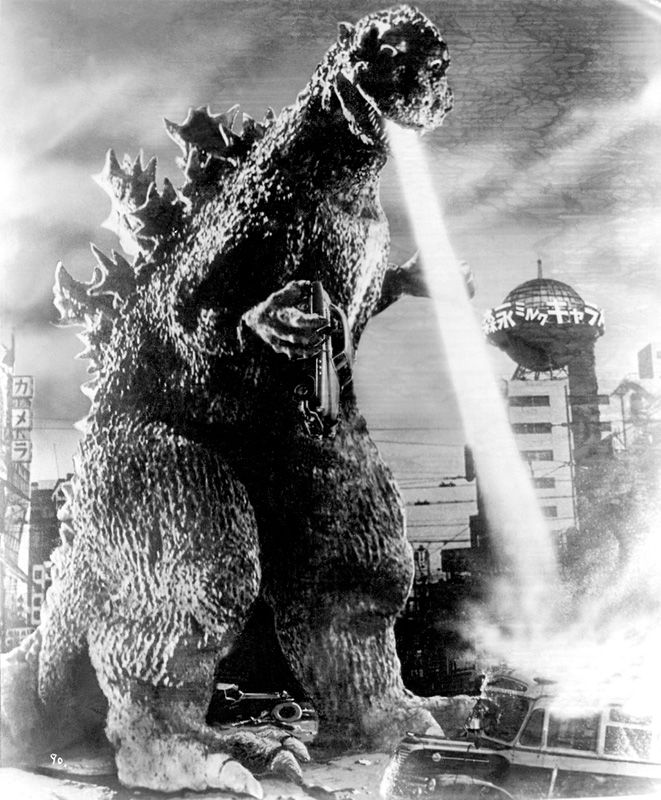 Another scene from the digitally remasteredGodzilla released in 2014. (Photo courtesy of Tōhō Co. Ltd.)
A film-processing technique called "optical compositing" was used for the movie, integrating the images of Godzilla taken in the studio with those of people fleeing from the monster, thus transporting viewers into the fictional world. Scenes where Godzilla shoots a estrus ray from its mouth were created using animation techniques to depict the monster's glowing dorsal fin and the beam of light. This effectively accentuated the terrifying physical presence of the giant dinosaur-like brute.
Overseas, there has been a strong tendency toward the depiction of realistic creatures in movies, whether it is the render of the dinosaurs or wild animals that go mammoth in size. This contrasts significantly with the monsters in Japanese movies like Godzilla, which have paranormal powers such every bit the ability to shoot a laser beam or rut ray, resulting from scientific causes. The image of these monsters took shape through careful orchestration that involved tangibly bringing the fantasy earth of the creatures to life through the apply of monster suits and miniature sets, and piling up innovative techniques such as combining an array of tokusatsu methods and compositions. The gap that arises from using realistic elements to describe imaginary creatures serves as a catalyst that stimulates the audience'southward imagination and creates an unparalleled sense of awe and surprise. This gets to the heart of the conception of Japanese tokusatsu and of its charms.
Tokusatsu Genre Spreads to Television set
After Godzilla became a hit in 1954, the following twelvemonth the motion-picture show Gojira no gyakushū (Godzilla Raids Again) was produced, with Tsuburaya given the title of the flick'south "special effects director." Tsuburaya, who became known as "the god of tokusatsu," was a hero for kids at the time. A new way of enjoying movies emerged, where people went to picture show theaters expressly to run across the tokusatsu effects and to run across that genre'southward distinctive character, Godzilla.
The cast of monster characters expanded to include Rodan, a rapid-flying bird resembling a pteranodon; Mothra, a giant caterpillar from a deserted island in the S Sea that transformed itself into a moth in Tokyo after forming its cocoon in the ruins of the Tokyo Tower; and King Ghidorah, a three-headed flying gold dragon In addition to these sorts of monsters, tokusatsu works feature an array of other characters, such every bit human beings who tin transform themselves into a gas or a liquid, and address a variety of themes, such as the threat of all-out nuclear war. Other product companies began to become involved in tokusatsu films, to the point where it developed into a major genre.
The tokusatsu genre moved on from film to the realm of television, which became the main media course. In 1966, three years after Astro Male child made its television debut, Tsuburuya Productions, a company created by that "divine" tokusatsu primary Tsuburaya Eiji, released the supernatural tokusatsu Television receiver series Ultra Q. The show immediately became a huge striking. This success overturned the fixed thought people in the manufacture had previously had that full-on tokusatsu effects were likewise expensive and time-consuming to be feasible for a Boob tube series. This sparked a "monster nail" on Telly, as each channel began producing its own tokusatsu programs.
That huge quantum made by the tokusatsu pioneer Tsuburaya led to major progress in the subsequent years. This trajectory was similar in many respects to how Astro Boy opened the way for anime series on television set. Moreover, both the character Astro Boy and Godzilla are intrinsically linked to diminutive power and an age of scientific engineering science. As a result of developing in such close connexion to Japan'southward era of extended economical growth, the state's anime and tokusatsu genres could blossom every bit a visual culture that has exerted a significant influence worldwide.
Ultraman Pioneers a New Format
Following up on the success of Ultra Q, Tsuburaya Productions released the new TV series Ultraman vi months later. Every week on the show a new monster appeared to threaten the planet. The hero of the prove, who battle these villains, is a member of a special constabulary with the power to transform himself into a giant humanoid from outer space.
The superhuman, justice-seeking Ultraman hero, designed in a style that combines elements of rockets and robots, became a symbol of the scientific know-how that sustained Nihon's economical growth of the fourth dimension. It's worth noting that, visually, the hero is a hybrid, with a silver torso to suggest that scientific aspect, interspersed with bands of cherry to announce his human quality.
Ultraman'due south new "monster of the week" format became a model for subsequent Telly shows geared to kids. For instance, 1972 saw the debut of Mazinger Z, a robot anime centered on an enormous super robot of the same name that is ridden in and operated by the show's hero, who does battle with evil mechanical monsters. The 1970s saw a string of anime shows featuring giant robots, culminating in the huge hitting Mobile Suit Gundam, starting time circulate in 1979.
Some other like sort of testify that debuted more recently, in 1995, is the highly successful Neon Genesis Evangelion, featuring enormous heroes like those in Ultraman, dressed in armor similar to that used in Mazinger Z. The show, with its combination of tokusatsu-fashion heroes and giant robots, marked the culmination of the genre'southward distinctive civilisation.
As the tokusatsu civilisation created by the offset Godzilla movie thus came to exert a huge influence on anime culture as well, in that location was a ripple issue that created many new characters, leading to swell progress. Meanwhile, though, the technique of using miniatures and other objects to bring a fantasy world to life began to decline equally figurer graphics came to the fore.
Simply by reconsidering the relationship betwixt anime and tokusatsu, and the course of their historical development, new breakthroughs that only Japan can bring to the world will no incertitude come up into view in the future—much like the astounding and unparalleled images the country'southward tokusatsu genre has brought to the world upwards to now. In that location is nonetheless room for the genre to develop once younger creators larn from its imaginative power and draw on the many innovative techniques that once had a worldwide touch.
At present that the world is again paying respect to the original Godzilla picture, that tokusatsu masterpiece, it seems an platonic time to forge new progress in this distinctive realm of Japanese visual civilization and to take a fresh look at the true value of the tokusatsu genre.
(Originally written in Japanese on June 16, 2014.)
belcherpithenclacke.blogspot.com
Source: https://www.nippon.com/en/views/b04001/
0 Response to "What Type of Art Style Is the Old Godzilla Movie"
Postar um comentário