Is It Better Fry or Boil Beef Heart

The Bristol's Beefiness Eye Jody Eddy hide caption
toggle caption
Jody Eddy
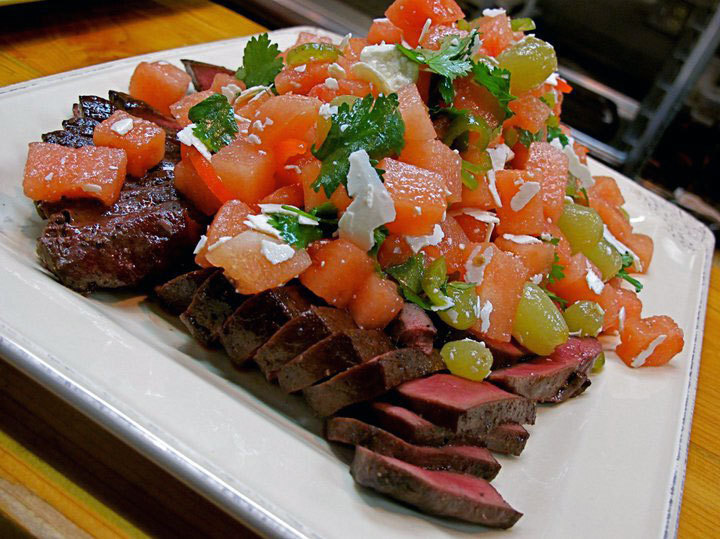
The Bristol's Beefiness Heart
Jody Eddy
Beefiness heart — it's what'south for dinner! Well, if you're not a vegetarian. Stick with us on this.
All Things Considered is launching a Found Recipe series Thursday, asking cookbook authors, chefs and bloggers to tell us about the dishes that surprise and delight. These are recipes stumbled upon or created past accident or by necessity.
And what better manner to starting time than beef middle — a meat with a long history of consumption start out of necessity and now, more than oft, out of pleasure, at least in this country.

To see what all the fuss is nearly, nosotros turned to cookbook authors Jody Boil and Christine Carroll, authors of Come up In, Nosotros're Closed, a volume about the kind of kitchen surprises that crop upwards when chefs at the country'southward all-time eateries utilize leftovers to make meals for their staff.
Eddy and Carroll's Found Recipe comes from The Bristol, in Chicago. It's owned and operated by Chef Chris Pandel, who is a large fan of cooking cuts of meat that many modern eaters tend to avoid: offal, or organ meat.
We're talking livers, kidneys, intestines, hearts.
Aye, offal practically rhymes with awful, but please go on an open heed: Eddy and Carroll swear that Chef Pandel'southward recipe for Beefiness Heart and Watermelon Salad is a revelation. "I call it steak ii.0," says Carroll "it's all the beef flavor for a fraction of the cost."
The centre is trimmed into iii steaks, quickly seasoned and seared in a bandage iron pan, so cut into sparse slices and topped with watermelon, pickled grapes, and ricotta salata cheese.
But to endeavor beefiness eye at home, Carroll had to get over some of the gore. "Even for me, an ex-line cook, beefiness heart is chillingly anatomical," she says, adding "simply you're rewarded with a marvelous protein ... which tastes securely bulky, with the faintest of mineral high notes and a slight chew like to hanger steak."
After she made the salad, Carroll ended up with some leftovers, which led to another Found Recipe. Since she had a baby merely starting on solids, she decided to slowly poach the beef heart in craven stock with some garlic. "When it was completely tender, I pureed it into the most rima oris-wateringly silky smooth beefy baby food you could possibly imagine." Her baby was so smitten with it that she fabricated the puree regularly and dubbed him "Captain Beef Eye" (not to exist confused with the eccentric 1960s rocker).
Meanwhile, Eddy shared this story with her Minnesota grandmother. Turns out, she ate beef heart while growing upwards on a dairy farm in the 1940s, as did many folks dorsum in the solar day when olfactory organ-to-tail eating in the U.South. was more necessity than fashion.
Eddy prepared the heart very much similar Pandel's seared beef heart at The Bristol, only she added blueberries, caramelized onions and grated horseradish, as her grandmother directed. "As we ate," Boil says, "I thought of Christine'southward young son and was really heartened by the appreciation the new generation seems to have for an ingredient the matriarch of my family had known most all along."
Listen to the All Things Considered interview with Carroll and Eddy above, and see their beefiness heart recipes below.
Beef Eye and Watermelon Salad
Most people presume beef heart shares a level of funk and fat similar to liver, kidney or gizzard. It decidedly does non. When seared and sliced thin as it is here, it could certainly be mistaken for pricier cuts of beefiness, only close observation would eventually reveal its telltale characteristic: the absence of any existent grain to the mankind. Selling for about $2 a pound (if you can find a farmer to haul one to the market for you), it is a thrifty stand-in for steak.
Serves 4
1 pound beef heart, trimmed into 3 steaks, each approximately 4 inches by vi inches (see Note below for trimming instructions)
Kosher salt and freshly ground black pepper to taste
2 tablespoons canola oil
4 ounces ricotta salata cheese (or feta)
3 cups cubed watermelon (1 inch cubes)
1 cup whole Pickled Grapes and 1/4 cup of their pickling liquid, reserved separately (see post-obit recipe)
ane/two bunch cilantro, leaves only, coarsely chopped
1/2 cup pitted Kalamata olives
one/iv cup thinly sliced Staff of life and Butter Jalapenos and 1/4 cup of their pickling liquid, reserved separately (see following recipe)
ane/four cup extra-virgin olive oil
Arugula or spinach leaves, for serving (optional)
Generously season the heart steaks with salt and pepper. In a large cast-atomic number 26 skillet, heat the oil over loftier heat. In one case it is smoking, sear the steaks on one side until a gilded brown crust has formed, nigh three minutes. Flip the steaks and sear for some other iii to 5 minutes, or until medium-rare (they should be bright crimson in the middle, rimmed past almost one/iv inch of seared meat). Remove from the pan and let rest on a cutting board for eight minutes.
Shave the ricotta salata with a vegetable peeler into strips and set aside. Combine the watermelon, grapes, cilantro, olives, and jalapenos in a large basin. In a divide bowl, whisk together the pickling liquids and olive oil.
After the heart steaks have rested, cut them into thin, long slices and arrange on a platter. Dress the watermelon salad with one-half the dressing, then season with salt, pepper, and additional dressing to gustatory modality. Spoon the watermelon salad over the beef eye and top with the ricotta salata. Serve while the beefiness middle is even so slightly warm, with fresh arugula on the side, if desired, to catch the extra juices and dressing.
A Note On Trimming A Beef Middle
To turn a fresh or completely defrosted beef heart into steaks, first trim off whatever large amounts of hard, white fat and veinlike ventricles visible on the outside of the heart. Leaving some fat behind is fine, as it helps lubricate the lean meat. Split up the heart open (but non in two) past cutting down one side, starting from the hole on the top. Using modest, quick strokes of a sharp pocketknife, release whatsoever internal structures holding the heart together to allow it to lie flat. Once it is butterflied, two-thirds of the heart will lie flat, and i-third will stick upward from the eye. Using this natural delineation, cut the heart into three "steaks," all approximately the same size. Now faced with more manageable pieces, trim off any fat and ventricles, including the slightly opaque silvery skin on both sides of each steak. It helps to employ the sharpest, thinnest knife yous own. Go on trimming until you have uncovered the smoothen, shiny, dark maroon flesh that lies underneath, at which signal the centre steaks are set for the pan.
Pickled Green Grapes
To accelerate the cure time for these unique pickles to a mere 24 hours, The Bristol calls for peeled grapes. (They use green table grapes, only any color will piece of work as long every bit they are very crisp.) With no real shortcuts to quickly peel one, we can only presume this chore falls to the lowest cook on the totem pole. If you detect your Zen in repetitive kitchen tasks, by all means peel away, simply slicing off the stem end of the grapes will work just besides (though they will crave a few more days in the alkali).
Yield: 1 quart
1 loving cup apple cider vinegar
1/ii loving cup rice vinegar
ane/2 cup granulated sugar
1 small cinnamon stick
1 1/two pounds seedless green grapes
Scrub a 1 quart glass jar and its lid in hot soapy water. Rinse well and air-dry.
In a small pot combine the vinegars, saccharide, cinnamon stick, and 1 cup water. Bring to a eddy, lower the rut, and simmer until the sugar is dissolved, about 5 minutes. Remove from the heat and cool to room temperature.
Wash and dry the grapes, discarding any moldy or mushy suspects. Remove the stems and, using a minor, precipitous knife, cut a thin slice off the stem end to expose the flesh. Cram as many grapes every bit will fit snugly into the jar.
When the liquid is cool, ladle it over the grapes about to the top of the jar, making certain to include the cinnamon stick. Screw on the hat, label the contents, and refrigerate for a minimum of 72 hours. The longer the grapes pickle, the improve they sense of taste (only the less crisp they get), and they tin can be stored in your refrigerator for upward to ii months.
Bread And Butter Jalapenos
This pickled jalapeno recipe in the "bread and butter" style — equally sweet equally it is sour — was invented after a summer market place windfall left The Bristol with more 200 pounds of the spicy peppers.
Yield: i quart
16 to xx dark-green jalapeno peppers
3/4 cup white wine vinegar
1/2 cup granulated sugar
one/ii teaspoon whole yellow mustard seeds
1/2 teaspoon whole coriander seeds
1/2 teaspoon whole fennel seeds
one/2 teaspoon black peppercorns
1 bay leaf
Scrub a one quart glass jar and its chapeau in hot soapy water. Rinse well and air-dry.
Wash and dry the jalapenos. Prick each ane several times with a fork. Stuff the jar with as many peppers as y'all tin.
In a pocket-sized pot, combine the remaining ingredients with iii/iv loving cup water. Bring to a boil, reduce the heat, and simmer until the carbohydrate is dissolved, nigh 5 minutes. Remove from the rut and carefully cascade the hot liquid and spices over the jalapenos to almost the meridian of the jar. (A large-mouthed funnel may be useful hither.)
Seal the jar tightly with the lid, characterization with the date of creation, and air-condition for a minimum of one week. The brine becomes spicier over time and makes excellent vinegar for dressings. The peppers can be stored for upward to two months in the refrigerator.
Storage: 2 to 3 months in the fridge.
Poached Beefiness Heart Infant Food
two cups sodium-free beef or craven stock
1 pound beef heart, trimmed and cut into one inch cubes
1 clove garlic, sliced
Pinch of salt (optional)
Over high oestrus, bring the stock to a boil in a medium saute pan. Add the beef center and enough cool water to submerge the pieces. Briefly return the liquid to a eddy and so lower the heat to maintain a gentle simmer. Add the optional garlic; cover the pan with a chapeau. Poach on the stove for 30 minutes or until the pieces are completely tender and easily pierced with a knife. Remove the beef heart from the stock, reserving both separately and cooling for ten minutes.
Add the cooked beef heart, 1/2 cup of stock and a compression of table salt to a large blender or food processor. Carefully blend into a smooth puree, adding more cooled stock as necessary to accomplish the desired consistency. If you accidentally overshoot on the stock and the puree becomes watery, add boiled sweet spud, overcooked pasta, or powdered chocolate-brown rice cereal to thicken it over again. (Reserve any remaining stock for soups, stews, or to rehydrate legumes.) And if you desire an even smoother consistency, push the puree through a fine mesh sieve discarding whatever lumpy solids left behind.
Decant the baby nutrient into a make clean basin and encompass the surface with plastic wrap. Once cooled to a "baby appropriate" temperature, serve in generous portions to your adventurous eater.
Extra puree tin can be poured into ice cube trays, covered, and stored in the freezer for up to 3 months.
belcherpithenclacke.blogspot.com
Source: https://www.npr.org/sections/thesalt/2012/10/25/163618582/beef-heart-an-unexpected-meal-that-spans-generations
0 Response to "Is It Better Fry or Boil Beef Heart"
Postar um comentário